

Converting a large amount in one trade often costs extra, because the price moves with the size of the order. TWAP (time-weighted average price) spreads that order into smaller slices over a period you choose, so you pay close to the average price across that period instead. In the illustrative example below, that saves about 28,000 USD on a 10 million USDC purchase with Mexican pesos.
TWAP is standard on trading desks. On Checker, PSPs, remittance companies, and neobanks without a desk can run it directly from their Checker Dashboard.
A TWAP order takes one large instruction, like "buy 10 million USDC over the next hour," and breaks it into equal slices placed at fixed intervals. Each slice trades at the price available at that moment, so the full order fills close to the average price over the window.
Checker's TWAP is time-weighted only. VWAP (volume-weighted average price) works differently: it sizes slices by how much the market is trading and places more when volume is high.
A large order asks the market to absorb a lot of size at once. A provider quoting 10 million USDC in one go has to price the cost of sourcing or hedging all of it immediately, so the quote moves with the size. On an order book, a large order fills through several price levels. Either way, the bigger the order, the less favorable the price.
This matters most in pairs with less trading volume, such as some stablecoin and local-currency pairs that trade mostly over the counter. Smaller orders are easier for the market to fill at a normal price, and the time between slices lets the market recover before the next one.
Illustrative example. Prices are not real quotes.
Let’s say a PSP needs to buy 10 million USDC with Mexican pesos (MXN), and the market is at 18.5000 MXN per USDC.
Option one is a single trade. The provider prices in the size and the order fills at 18.5740.
Option two is TWAP over one hour, with a slice every 10 minutes. That's six slices of about 1.67 million USDC each, filling at 18.5150, 18.5200, 18.5180, 18.5260, 18.5240, and 18.5290. The average is 18.5220.
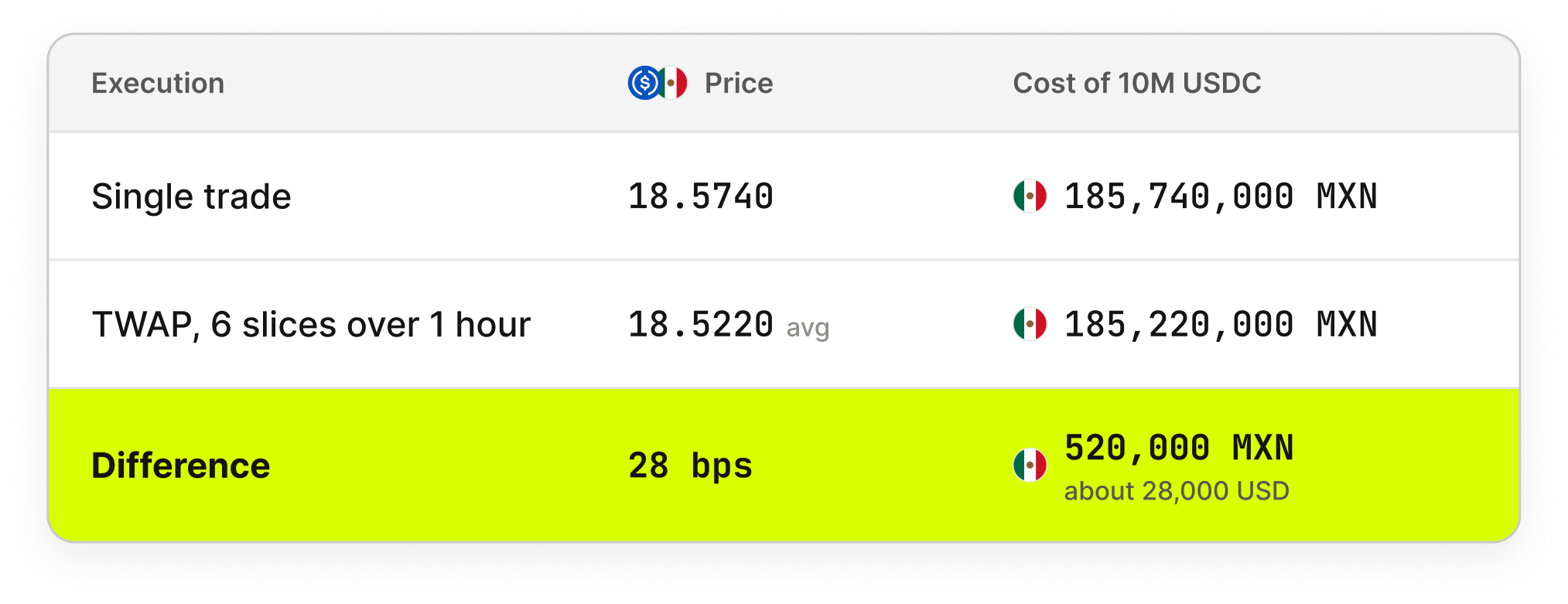
TWAP is useful when:
Start with the window, because it carries the main trade-off. A longer window gives the market more time to absorb each slice but leaves more time for the price to move. A shorter window cuts that exposure, but each slice is bigger.
The frequency then sets the slice size. The number of slices is the duration divided by the frequency, so one hour with a slice every 10 minutes gives six. Pick a window your business can wait for, then a frequency that brings each slice down to a size the pair handles at one quote.
To use TWAP, ask Checker to enable it for your team. Once it’s on, you choose the pair, buy or sell, the amount, how long the order runs, how often a slice is placed, and the provider. Before you confirm, the dashboard shows the number of slices, the size of each, and when the first and last slices run.
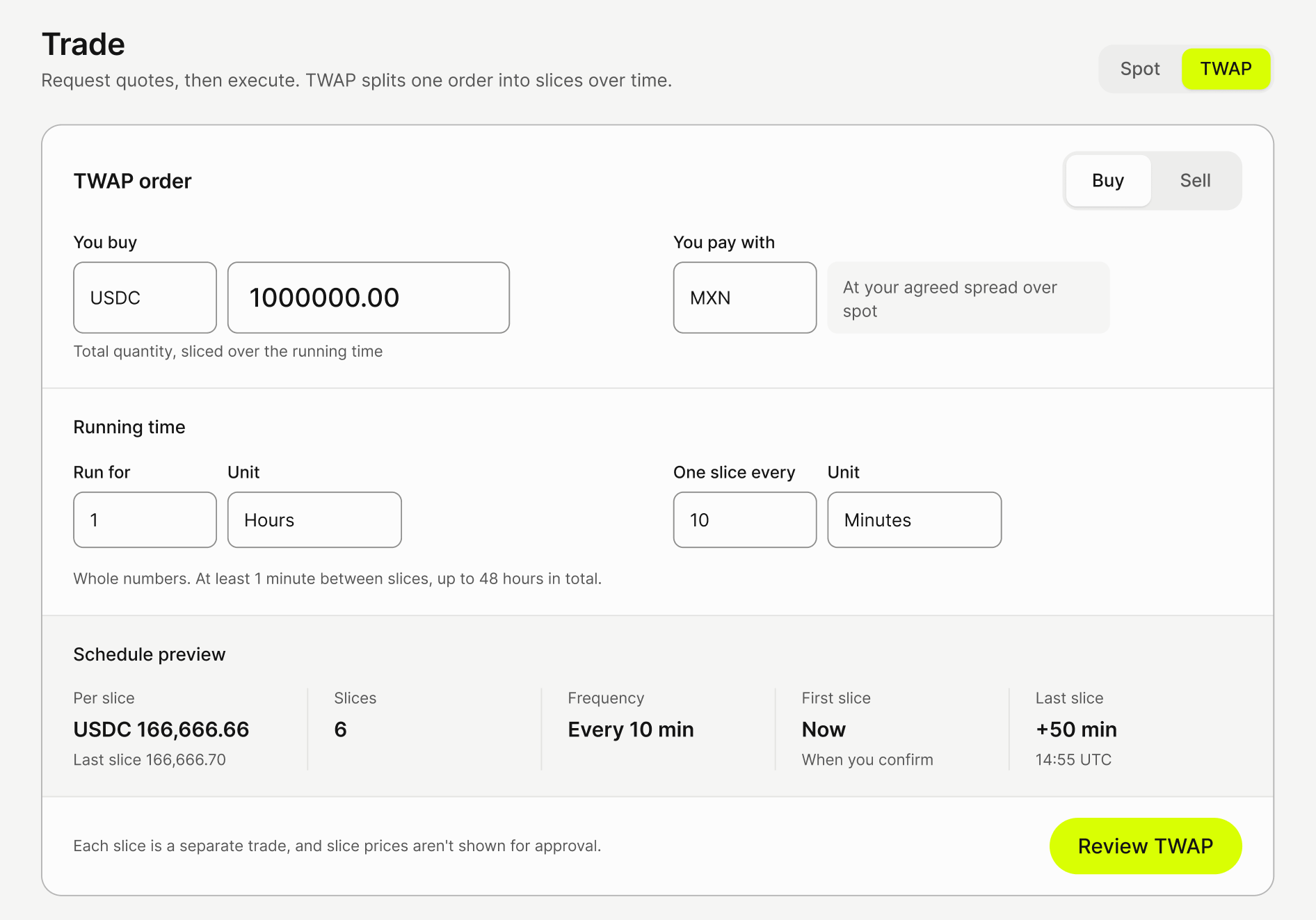
The first slice executes as soon as you confirm, and the rest run on schedule, so nobody has to place trades by hand. Each slice is a separate trade with the provider you chose, at the spread you've agreed with them over spot. Every slice appears in your trade blotter as it fills, so your finance team has a record of each price. Funds settle through that provider. Checker gives you access to it and places each slice.
A TWAP order from setup to the trade blotter. The video uses different illustrative figures from the example above. Prices are not real quotes.
If you move large stablecoin or FX orders, talk to our team about setting up TWAP.
